 English
 русский
 Français
 عربى
عربى Español
 Português
 简体中文
简体中文
Quelle est la durée de vie moyenne des ensembles de bureau et de chaises en bois et acier à hauteur réglable ?
Un produit bien fabriqué ensemble bureau et chaise réglable en hauteur en acier et bois utilisé dans les classes des écoles primaires et secondaires dure généralement entre 8 et 15 ans dans des conditions normales. Les ensembles de haute qualité produits sur des lignes de production automatisées avec des cadres en acier robustes, des surfaces en bois durables et des finitions de peinture de qualité peuvent atteindre ou dépasser l'extrémité supérieure de cette fourchette lorsqu'ils sont correctement entretenus. Les ensembles soumis à une utilisation quotidienne intensive par des populations étudiantes en rotation – comme c'est généralement le cas dans les environnements scolaires – subiront naturellement plus d'usure que les meubles à usage domestique, mais une conception réfléchie, des matériaux de qualité et un entretien de routine peuvent prolonger considérablement la durée de vie. Comprendre les facteurs qui déterminent la longévité aide les écoles, les parents et les responsables des achats à prendre de meilleures décisions d'achat et à établir des pratiques de maintenance efficaces.
Content
- 1 Pourquoi la durée de vie est importante pour les ensembles de bureaux et de chaises d'école
- 2 Répartition de la durée de vie moyenne par composant
- 3 Facteurs clés qui déterminent la durée d'un ensemble
- 4 Comment la conception ergonomique contribue à la valeur à long terme
- 5 Pratiques de maintenance qui prolongent la durée de vie
- 6 Normes de qualité et certifications à rechercher
- 7 Signes indiquant qu'un ensemble bureau et chaise a atteint la fin de sa durée de vie
- 8 Choisir des ensembles conçus pour une longévité maximale
- 9 Résumé de la durée de vie : à quoi s'attendre de manière réaliste
Pourquoi la durée de vie est importante pour les ensembles de bureaux et de chaises d'école
Les bureaux et les chaises font partie des meubles les plus utilisés dans tout établissement d'enseignement. Une seule salle de classe peut accueillir des centaines d'élèves différents au cours de sa durée de vie opérationnelle, chaque élève dépensant en moyenne 6 à 8 heures par jour assis à leur bureau pendant l’année scolaire. Sur une durée de vie de 10 ans, une chaise de bureau installée dans une salle de classe standard pourrait accumuler plus de 15 000 heures d'utilisation active — un profil de demande qui dépasse de loin la plupart des meubles résidentiels.
Au-delà de l’aspect économique, l’état physique du mobilier scolaire a un impact direct sur la santé des enfants. Les ensembles de bureaux et de chaises réglables en hauteur sont spécialement conçus pour soutenir une bonne posture, un alignement de la colonne vertébrale et un positionnement ergonomique pendant les années critiques de développement de l'enfance et de l'adolescence. Les meubles dégradés (avec des mécanismes de réglage lâches, des surfaces inégales ou des cadres instables) n'offrent plus ces avantages et peuvent contribuer activement à de mauvaises habitudes de posture et à un inconfort musculo-squelettique. Comprendre et gérer la durée de vie des meubles n’est donc pas seulement une question de budget mais aussi un problème de bien-être des étudiants.
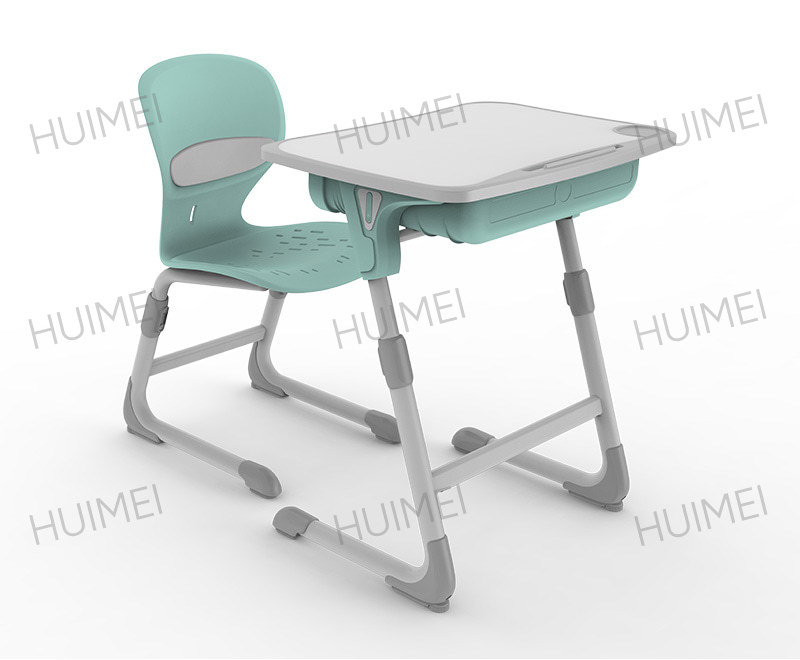
Répartition de la durée de vie moyenne par composant
Les ensembles de bureaux et de chaises en acier et en bois réglables en hauteur sont des produits composites : chaque composant principal a ses propres caractéristiques d'usure et sa durée de vie typique. Comprendre cette panne aide à diagnostiquer quand un ensemble doit être réparé, remplacé partiellement ou mis hors service complet.
| Composant | Matériel | Durée de vie typique (utilisation scolaire) | Indicateurs d'usure courants |
|---|---|---|---|
| Structure en acier (bureau) | Acier laminé à froid, revêtement par poudre | 12 à 20 ans | Rouille au niveau des joints, tubes pliés, peinture écaillée |
| Structure en acier (chaise) | Acier laminé à froid, revêtement par poudre | 10 à 15 ans | Wobble, fissuration des soudures, corrosion de surface |
| Surface de bureau en bois | MDF / panneaux de particules / bois massif | 8 à 12 ans | Pelage superficiel, gonflement des bords, rayures profondes |
| Assise/panneau arrière en bois | Contreplaqué moulé / bois massif | 8 à 15 ans | Fissuration, délaminage, usure superficielle |
| Mécanisme de réglage de la hauteur | Goupilles en acier, fentes, matériel de verrouillage | 8 à 12 ans | Ajustement rigide, défaillance des broches, usure de la fente |
| Patins de sol / couvre-pieds | Plastique ou caoutchouc | 3 à 6 ans | Porté à plat, manquant, gratte le sol |
| Peinture / Revêtement | Revêtement en poudre électrostatique | 6 à 12 ans | Écaillage, décoloration, rouille sous le poil |
Les données ci-dessus illustrent un principe important : le cadre en acier est généralement le composant le plus durable, tandis que les surfaces en bois et les mécanismes de réglage sont plus susceptibles de limiter la durée de vie globale de l'ensemble. Dans de nombreux cas, un cadre en acier structurellement solide avec un bureau usé ou un panneau de siège endommagé peut être partiellement remis à neuf plutôt que entièrement remplacé – une approche qui prolonge la durée de vie efficace et réduit les coûts de remplacement.
Facteurs clés qui déterminent la durée d'un ensemble
La moyenne sur 8 à 15 ans est une fourchette et non un nombre fixe. Plusieurs variables spécifiques poussent la durée de vie réelle vers une extrémité ou l’autre de cette plage. Les écoles et les responsables des achats qui comprennent ces facteurs peuvent prendre des décisions qui s’orientent systématiquement vers le long terme.
Qualité du cadre en acier et précision de fabrication
La structure en acier constitue l’épine dorsale structurelle de l’ensemble. Cadres fabriqués à partir de acier laminé à froid de haute qualité avec des épaisseurs de paroi de 1,2 mm ou plus résistent bien mieux à la flexion et à la déformation que les alternatives à parois plus minces. La qualité des soudures au niveau des joints, en particulier aux points de connexion de l'assise, du dossier et des pieds, est essentielle : de mauvaises soudures se fissurent sous des charges répétées et des contraintes latérales. Les finitions en poudre appliquées par pulvérisation électrostatique et durcies à haute température offrent une adhérence et une résistance à la corrosion nettement supérieures à celles de la peinture liquide, ce qui a un impact direct sur la durée pendant laquelle le cadre résiste à la rouille dans les environnements humides des salles de classe.
Les fabricants opérant avec des lignes de production automatisées de pointe – qui maintiennent des tolérances dimensionnelles strictes et une qualité de soudure constante dans chaque unité – produisent des cadres qui fonctionnent de manière plus fiable et durent plus longtemps que ceux fabriqués sur des équipements de production moins contrôlés. Une qualité constante sur l'ensemble d'un lot de production signifie que chaque bureau et chaise d'une commande de salle de classe fonctionne selon les mêmes normes, plutôt que de présenter de grandes variations dans la durée de vie entre les unités individuelles.
Matériau de la surface en bois et qualité de finition
La durabilité des panneaux de bureau et de siège dépend fortement du matériau du substrat et de la qualité de la finition de surface qui lui est appliquée. Les options de substrat courantes dans le mobilier scolaire comprennent :
- Panneaux de fibres haute densité (HDF/MDF) : Dense et lisse, supporte bien les bandes de chant, mais est susceptible d'absorber l'humidité sur les bords exposés si le traitement des bords est inadéquat.
- Panneaux de particules avec stratifié mélamine : Rentable avec une bonne durabilité de surface lorsque l’adhérence du stratifié est forte ; les bords doivent être scellés pour éviter le gonflement
- Contreplaqué moulé (pour les panneaux d'assise et de dossier) : Excellent rapport résistance/poids, formage flexible et bonne résistance à la fissuration sous charge ponctuelle lorsqu'il est correctement fabriqué
- Bois massif : Durabilité et réparabilité maximales, mais plus lourdes et plus coûteuses ; utilisé dans le mobilier scolaire de qualité supérieure
Des finitions de surface qui sont résistant aux rayures, facile à nettoyer et résistant aux taches courantes d'encre et de solvants sont particulièrement importants dans le contexte scolaire. Les textures de couleur claire avec des finitions mates ou satinées, telles qu'utilisées dans les lignes de mobilier de salle de classe bien conçues, aident à dissimuler l'usure mineure de la surface tout en conservant une esthétique propre en classe au fil du temps. Les finitions stables aux UV empêchent le jaunissement ou la décoloration sous l'exposition à la lumière fluorescente et naturelle.
Conception du mécanisme de réglage de la hauteur
Le mécanisme de réglage de la hauteur est l'élément fonctionnel déterminant de cette catégorie de meubles et également l'un des composants les plus résistants à l'usure. Les mécanismes qui nécessitent des outils ou une force excessive pour être ajustés ont tendance à être laissés dans une position fixe par les enseignants ou les étudiants, annulant ainsi totalement l'avantage ergonomique. Les conceptions les plus durables et les plus conviviales utilisent systèmes à action douce à goupille et fente ou actionnés par levier avec des composants en acier qui résistent à la déformation sous des cycles de réglage répétés.
Les principaux indicateurs de durabilité des mécanismes de réglage comprennent : le nombre de positions en hauteur disponibles (plus de positions signifient des cycles de réglage plus fréquents au cours de la durée de vie du meuble), le matériau et la finition des goupilles de réglage et du matériel de verrouillage, ainsi que les tolérances de jeu entre les composants coulissants. Les mécanismes trop lâches tremblent et semblent instables ; ceux usinés selon des tolérances serrées offrent une sensation de sécurité et de stabilité qui persiste pendant des années d'utilisation.
États environnementales en classe
L’environnement de la salle de classe affecte directement la longévité des meubles. Une humidité élevée accélère le gonflement du bois et la rupture des bandes de chant, tout en favorisant la formation de rouille sur les cadres en acier, en particulier au niveau des joints où la couche de peinture est la plus fine. Les salles de classe des régions tropicales ou côtières pourraient voir la durée de vie des composants en bois 20 à 30 % plus courte. par rapport à ceux des climats plus secs et tempérés, à moins que les meubles ne soient spécifiquement conçus et finis pour une utilisation dans un environnement humide.
La lumière directe du soleil à travers les fenêtres de la salle de classe accélère la dégradation des finitions de surface par les UV et peut provoquer la déformation des panneaux de bois avec le temps. Les revêtements de sol durs – courants dans les bâtiments scolaires – augmentent la tension transmise aux pieds des chaises et aux patins lors du déplacement et du repositionnement. Les écoles dotées de sols durs devraient donner la priorité aux chaises dotées de patins de sol remplaçables de haute qualité pour protéger à la fois les pieds des chaises et le sol de la classe.
Intensité et modèle d'utilisation quotidienne
Le mobilier scolaire connaît des modes d’utilisation fondamentalement différents du mobilier résidentiel. Un pupitre et une chaise d'école peuvent être utilisés par 30 étudiants ou plus par jour sur plusieurs périodes de cours , avec des mouvements, des repositionnements fréquents et – dans les groupes d’âge plus jeunes – une manipulation plus brutale. Les meubles utilisés dans les écoles primaires (6 à 12 ans) subissent généralement plus de stress physique que les mêmes meubles utilisés dans les écoles secondaires, où les élèves sont plus susceptibles de manipuler les meubles avec précaution.
Les cours comportant une activité physique élevée (art, travaux de laboratoire scientifique, séances de projets de groupe) génèrent davantage de mouvements de meubles et d'exposition de surface aux liquides et aux matériaux artistiques que les cours magistral standard. Les meubles dans ces environnements devraient bénéficier d’une protection de surface supplémentaire et de programmes d’inspection plus fréquents.
Comment la conception ergonomique contribue à la valeur à long terme
Le réglage de la hauteur n’est pas simplement une fonctionnalité pratique : il s’agit d’une exigence ergonomique fondamentale pour le mobilier scolaire destiné aux enfants de tous âges et de toutes tailles. La taille des enfants varie jusqu'à 30 à 40 cm au sein d'un même niveau scolaire , et un bureau ou une chaise placé à la mauvaise hauteur force des postures compensatoires – épaules voûtées, épaules surélevées, pieds pendants – qui mettent à rude épreuve la colonne vertébrale et la musculature en développement.
Du point de vue de la durée de vie, la conception ergonomique contribue à la longévité de deux manières. Premièrement, un mobilier correctement ajusté à la taille du corps de l'élève répartit la charge plus uniformément sur la structure, réduisant ainsi la concentration des contraintes sur des articulations et des composants spécifiques. Deuxièmement, les meubles qui fonctionnent comme prévu – en maintenant une posture et un confort corrects – sont moins susceptibles d’être mal utilisés ou soumis à des types de contraintes structurelles (s’appuyer en arrière sur deux pieds, s’asseoir sur le côté, se tenir debout sur les panneaux du siège) qui accélèrent les dommages.
Le mobilier de salle de classe moderne conçu autour des environnements d'apprentissage des élèves utilise des textures fraîches et claires et des formes épurées et épurées qui créent une atmosphère calme et ciblée. Les recherches montrent systématiquement que le confort physique et un environnement visuel bien conçu contribuent tous deux à la concentration et à l’engagement créatif des étudiants – des avantages qui ne persistent que tant que le mobilier reste en bon état et fonctionne comme prévu.
| Groupe d'âge des étudiants | Plage de hauteur typique | Hauteur de bureau recommandée | Hauteur d'assise recommandée |
|---|---|---|---|
| Primaire (6 à 9 ans) | 110-135 cm | 52-58 cm | 29 à 33 cm |
| Primaire (10-12 ans) | 130-155 cm | 58-65 cm | 33-38 cm |
| Secondaire (13-15 ans) | 150-170 cm | 64-70 cm | 38-42 cm |
| Secondaire (16-18 ans) | 160-180 cm | 70-76 cm | 40-46 cm |
Pratiques de maintenance qui prolongent la durée de vie
Un entretien adéquat est la variable la plus contrôlable pour prolonger la durée de vie des bureaux et des chaises au-delà de la moyenne de référence. Les écoles qui mettent en œuvre des programmes de maintenance structurés atteignent systématiquement des durées de vie dans la partie supérieure de la fourchette attendue, tandis que celles qui effectuent uniquement des réparations réactives lorsque les meubles sont déjà gravement endommagés retirent souvent les ensembles des années plus tôt que nécessaire.
Soins quotidiens et hebdomadaires
- Nettoyez les surfaces du bureau avec un chiffon humide et une solution de nettoyage douce ; éviter les nettoyants abrasifs qui endommagent la finition de la surface
- Éliminez rapidement les résidus d'encre, de peinture ou d'adhésif avant qu'ils ne durcissent et nécessitent des méthodes de nettoyage agressives.
- Assurez-vous que les élèves soulèvent les chaises plutôt que de les traîner sur le sol afin de réduire la tension sur les soudures des pieds et de préserver le glissement du sol.
- Maintenez l'humidité de la classe dans une plage modérée lorsque cela est possible : une humidité excessive accélère le gonflement du bois et la corrosion de l'acier.
Inspection trimestrielle et annuelle
- Inspectez tous les joints et soudures du cadre à la recherche de signes de fissuration, de jeu ou de corrosion : une détection précoce empêche une défaillance structurelle.
- Tester les mécanismes de réglage de la hauteur sur chaque unité pour confirmer un fonctionnement fluide et sécurisé ; lubrifier les broches de réglage avec de l'huile de machine légère si une raideur est détectée
- Vérifiez tous les patins de sol et remplacez ceux qui sont usés à plat ou manquants : les patins endommagés permettent aux extrémités des tubes en acier d'entrer directement en contact avec le sol, accélérant ainsi rapidement les dommages au cadre.
- Inspecter les bandes de chant sur toutes les surfaces de bureau et de siège pour déceler tout soulèvement ou séparation ; recoller ou remplacer avant que la pénétration de l'humidité ne provoque un gonflement du substrat
- Corrigez les éclats de peinture ou les taches de rouille sur les cadres en acier avec de la peinture de retouche pour empêcher la propagation de la rouille.
- Serrez toutes les attaches desserrées reliant les panneaux en bois aux cadres en acier.
Stratégie de remplacement partiel
Lorsqu'un ensemble bureau et chaises a une structure en acier structurellement solide mais des panneaux de bois dégradés, le remplacement uniquement des composants en bois peut redonner à l'ensemble une fonction quasi neuve pour une fraction du coût de remplacement. Cette approche est plus viable lorsque le fabricant d'origine propose des panneaux de remplacement compatibles ou lorsque les dimensions des panneaux sont suffisamment standard pour permettre une fabrication personnalisée. Les écoles qui adoptent une stratégie de remplacement partiel peuvent effectivement doubler la durée de vie utile de l'investissement dans la charpente en acier. , réalisant d'importantes économies à long terme sur un vaste inventaire de mobilier de salle de classe.
Normes de qualité et certifications à rechercher
Lors de l'achat de mobilier scolaire en acier et en bois réglable en hauteur, les certifications de qualité et le respect des normes reconnues fournissent une base objective pour comparer les produits et évaluer leur durée de vie probable. Les meubles qui ont été testés par rapport aux normes établies en matière de résistance structurelle, de durabilité des surfaces, de sécurité des matériaux et de conformité environnementale sont plus susceptibles d'atteindre l'extrémité supérieure de la fourchette de durée de vie.
- Tests de charge structurelle : Les normes pertinentes spécifient les exigences minimales en matière de charge pour les surfaces de bureau (généralement des charges statiques de 100 à 150 kg appliquées au centre du bureau) et la résistance dynamique aux chutes et aux chocs pour les panneaux de siège.
- Normes d'émission de formaldéhyde : Les substrats et adhésifs en panneaux de bois doivent respecter les limites d'émission E1 ou E0 (E1 : ≤0,124 mg/m³ ; E0 : ≤0,05 mg/m³) afin de garantir une qualité d'air intérieur sûre pour les enfants qui passent de longues heures en classe.
- Résistance à l'abrasion superficielle : Les surfaces de bureau doivent répondre à des cycles d'abrasion minimum (généralement 100 à 200 cycles dans des conditions de test standardisées) sans dégradation significative de la surface.
- Adhérence de la peinture et résistance à la corrosion : Les finitions en poudre sur les cadres en acier doivent réussir les tests d'adhérence transversale et les tests de corrosion au brouillard salin conformément aux normes applicables.
- Certification de gestion de la qualité ISO 9001 : Les fabricants titulaires de la certification ISO 9001 opèrent selon des systèmes de gestion de la qualité documentés qui contrôlent la cohérence de la production – un indicateur clé que chaque unité d'un lot répond à la même norme de qualité.
- Certification nationale obligatoire du produit (le cas échéant) : Dans les régions dotées de systèmes de certification de sécurité obligatoires pour le mobilier scolaire, la certification de conformité fournit l'assurance de normes minimales de sécurité et de qualité.
Les fabricants dotés de capacités de conception internationales, de lignes de production automatisées avancées pour les pièces en acier, les pièces en bois et les pièces peintes, et d'une expérience en tant que régulateurs de l'industrie sont en mesure de fournir des meubles qui respectent ou dépassent systématiquement ces références. Huimei , par exemple, apporte cette combinaison de normes de conception internationales et de technologie de production automatisée à sa gamme complète de produits de bureaux et de chaises d'école, garantissant que la qualité, le respect de l'environnement et la sécurité sont intégrés dans chaque ensemble plutôt que de manière incohérente.
Signes indiquant qu'un ensemble bureau et chaise a atteint la fin de sa durée de vie
Même les meubles bien entretenus finissent par atteindre un point où une utilisation continue est soit dangereuse, soit n’est plus appropriée du point de vue ergonomique. La reconnaissance de ces indicateurs empêche les écoles de conserver du mobilier qui ne peut plus remplir la fonction prévue.
| Condition | Composant Affected | Niveau de risque | Action requise |
|---|---|---|---|
| Oscillation ou instabilité du cadre | Soudures ou joints de charpente en acier | Élevé – risque de blessure | Retirer immédiatement de l'utilisation ; évaluer pour une réparation ou un remplacement |
| Panneau de siège fissuré ou fendu | Siège en bois | Élevé – risque de lacération | Remplacez le panneau de siège ou retirez l'ensemble |
| Mécanisme de réglage non fonctionnel | Système de réglage de la hauteur | Moyen – échec ergonomique | Mécanisme de réparation ; remplacer si cela n'est pas rentable |
| Délaminage étendu de la surface | Surface de bureau | Moyen — risque d’hygiène et d’éclats | Remplacez le panneau du bureau ; retirer si le cadre est également compromis |
| Rouille avancée sur les tubes structurels | Structure en acier | Élevé – perte d’intégrité structurelle | Prenez votre retraite immédiatement |
| La taille n'est plus réglable en fonction de la taille des étudiants | Ensemble complet | Moyen – inadéquation ergonomique | Redéployer vers les classes plus jeunes ou remplacer par un modèle plus grand |
Choisir des ensembles conçus pour une longévité maximale
Tous les ensembles de bureaux et de chaises réglables en hauteur ne sont pas construits selon les mêmes normes, et les choix faits au stade des spécifications et de l'approvisionnement ont un impact plus important sur la durée de vie à long terme que tout programme de maintenance ultérieur. Les acheteurs qui se concentrent sur les critères suivants lors de la sélection obtiennent systématiquement une meilleure valeur à vie.
- Spécifiez l’épaisseur de paroi du tube en acier : Exigez une épaisseur de paroi minimale de 1,2 mm pour les pieds de chaise et les cadres de bureau ; 1,5 mm ou plus pour les points de charge élevée tels que le cadre du siège de la chaise et les coins du cadre du bureau
- Exiger une finition par revêtement en poudre avec certification d'adhérence : Les finitions en poudre électrostatique durcies à des températures appropriées offrent une adhérence, une résistance aux chocs et une protection contre la corrosion nettement supérieures à celles de la peinture liquide.
- Évaluer l’action du mécanisme d’ajustement en personne : Tester des échantillons avant de vous engager dans une commande importante ; l'ajustement doit être fluide, positif et ne nécessiter aucun outil ; le verrouillage doit être ferme et sans jeu une fois réglé
- Confirmez la qualité du substrat du panneau de bois et des bandes de chant : Inspectez les bandes de chant pour une adhérence constante et sans espaces ; vérifier les bords des panneaux pour une étanchéité adéquate ; demander des certificats de test d'émission de formaldéhyde
- Évaluez la disponibilité des pièces de rechange : Confirmer auprès du fabricant que les patins, les goupilles de réglage et les panneaux de bois sont disponibles comme pièces de rechange ; les meubles soutenus par un solide programme de pièces de rechange ont une durée de vie intrinsèquement plus longue
- Sélectionnez un fabricant avec une production automatisée et des systèmes de qualité documentés : Une qualité de production constante sur l'ensemble d'un lot n'est possible que grâce à des processus automatisés avec des tolérances contrôlées ; vérifier la certification ISO 9001 et poser des questions sur les capacités de la ligne de production
- Faites correspondre le modèle au scénario d’enseignement : Différents types de salles de classe – cours magistral standard, laboratoire scientifique, salle d’art, salle informatique – génèrent différents profils de stress ; choisir des modèles spécialement conçus et testés pour l’environnement d’utilisation prévu
Les fabricants aiment Huimei , avec des capacités de conception internationales de premier ordre et des lignes de production entièrement automatisées couvrant toutes les catégories de pièces en acier, de pièces en bois et de pièces peintes, est structuré pour fournir des meubles qui répondent systématiquement à ces critères, aidant ainsi les écoles à atteindre l'extrémité supérieure de la fourchette de durée de vie de 8 à 15 ans dans l'ensemble de leur inventaire de mobilier de salle de classe.
Résumé de la durée de vie : à quoi s'attendre de manière réaliste
Le tableau ci-dessous consolide les attentes en matière de durée de vie des ensembles de bureaux et de chaises d'école en acier et en bois réglables en hauteur pour différents scénarios d'utilisation et de qualité.
| Scénario | Durée de vie prévue | Facteurs déterminants clés |
|---|---|---|
| Ensemble de qualité, entretien adéquat, climat tempéré | 12 à 15 ans | Matériaux haut de gamme, inspection régulière, faible humidité |
| Ensemble de bonne qualité, entretien standard, usage scolaire typique | 8 à 12 ans | Qualité standard, inspection annuelle, conditions modérées |
| Ensemble de qualité moyenne, entretien minimal, climat humide | 5 à 8 ans | Acier plus fin, finition de base, entretien réactif uniquement |
| Ensemble de moindre qualité, pas de programme de maintenance structuré | 3 à 6 ans | Mauvaise sélection des matériaux, aucune inspection, conditions d'utilisation intensive |
| Structure en acier with partial replacement of wooden panels | 15 à 20 ans (cadre) | Qualité du cadre, disponibilité des pièces, remise à neuf proactive |
Le message central est clair : la qualité au point d'achat, combinée à un programme de maintenance structuré, est le moyen le plus fiable d'atteindre une durée de vie maximale des ensembles de bureaux et de chaises d'école en acier et en bois réglables en hauteur. Les écoles qui investissent dans du mobilier de bonne qualité et le gèrent de manière proactive verront leur investissement apporter des avantages ergonomiques, éducatifs et environnementaux sur une décennie ou plus de service.
